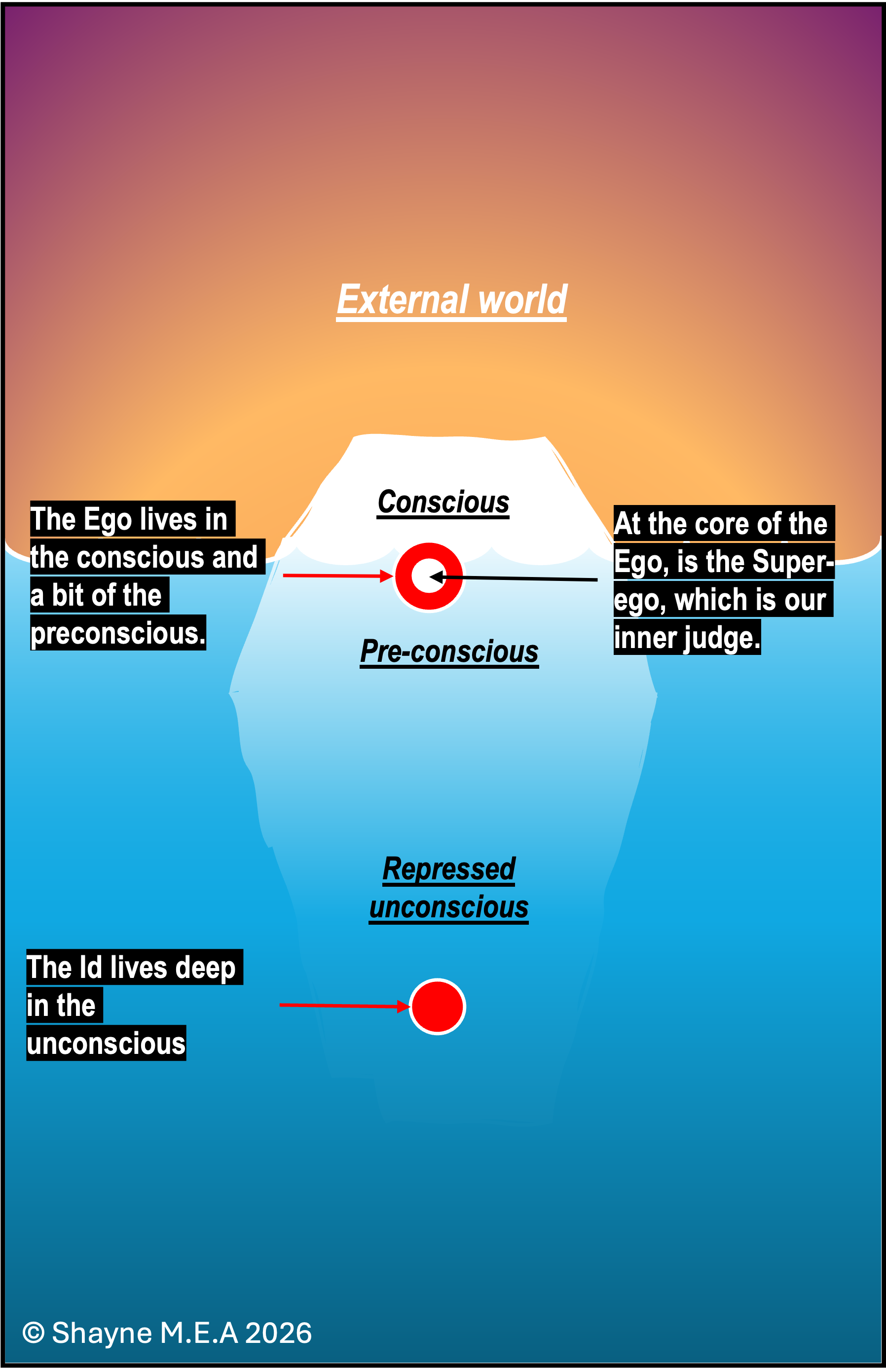
The Super-ego is at the core of our Ego. It contains our moral compass and acts as our inner judge, giving us our sense of right and wrong.
Super-ego
The Super-ego's purpose is to close off the Oedipus complex. It tells the child that although they love their Mum and Dad, they can never be fully like them.
The stronger the love a child has for their parents, and the quicker that love is repressed, the stricter and more punishing the Super-ego becomes. This can often make individuals feel morally pressured or feel guilty without knowing why.
The Super-ego is more connected to the Id than it is with the conscious mind. The emotional force of the Super-ego comes from the Id, not from our learnt understanding of the word alone.
So if the Ego is formed through word presentations (things we have learnt and heard from the external world), then the Super-ego can be thought of as being partially formed through word presentations and partially formed from the Id.
The Super-ego is heavily influenced by two things:
- Biology: children stay dependent on their Mum and Dad for a long time. So it's common for the Super-ego to borrow traits from a child's parents as they grow up.
- History/psychology: As their Egos become stronger, children will begin to resolve the Oedipus complex by supressing their desires towards their parents. In doing so, the Super-ego will internalise any traits resulting from the identification process carried out when the Oedipus complex was resolved.
Ego-ideal
The Ego-ideal is your idea of what the ideal or the perfect human is, it develops from our Mum and Dad and continues to develop from our teachers as we grow up, shaping our morals, expectations and beliefs. When we don't meet this ideal we start to feel guilty.
Ego, Super-ego and Ego-ideal
Our Ego, Super-ego and Ego-ideal are the result of us destroying the Oedipus complex.
| Ego | Deals with our perception of reality, and mediates between the external world, the Super-ego and the Id. |
|---|---|
| Super-ego | Deals with morals and gives us our sense of right and wrong. |
| Ego-ideal | Represents our idea of what perfection is. |
Guilt
Guilt arises when the Super-ego's understanding of the Ego-ideal clashes with the Ego's perception of reality. In other words, guilt arises when the Ego is unable to meet the standards of the Ego-ideal.
For example:
Our Ego would say, "I am tired, I can't go to my friend's party tonight." The Super-ego would say, "That's not good enough, good friends go to all parties, because that's what the perfect human would do."
Sometimes we see a phenomenon where people say they're still sick, even though the doctor can see they're getting better. They refuse to admit they're getting better out of guilt, and this guilt manifests into them feeling sick. It's often a big part of why people don't get better even though the treatments are promising.
A lot of guilt is unconscious and arises from the Oedipus complex in the desire to detach from the parents.
Sometimes guilt can cause crime. A person won't feel guilty because they committed the crime, but the guilt was always there and the crime was a way to deal with it.
Example Melancholia
In cases such as melancholia (depression), the Ego agrees with the Super-ego, and accepts that they've done bad things and should be punished.
Example OCD
In cases such as OCD, the Id creates inner feelings that go against the Ego-ideal. To deal with this guilt, the Ego will use a mechanism called reactive formations, which is when the Ego does the opposite of these inner feelings. For example, if they feel hostile, then they become kind.
Example Hysteria
In cases such as hysteria, the guilt is unconscious, because the Ego suppresses the guilt. Usually the Ego tries to work with the Super-ego, but in this case it completely goes against it and hides the guilt altogether.
Example Obsessional Neurosis
In the case of obsessional neurosis, love towards a person turns into hate towards a person. When this happens the Id contains aggressive impulses towards a loved one, the Ego tries to suppress the thoughts because it's not appropriate. Then the Id turns on the Ego for not giving it what it wants, and the Super-ego makes the Ego feel guilty for even considering those thoughts to begin with.
Inheriting Morals
The morals that we develop have most likely come from our ancestors. That sense of care, kindness and community came from our ancestors having to deal with rivalry.
Sometimes, behaviours and emotional experiences are so common and so strongly felt across a community that a person's Ego might shove those experiences deeply into the Id and lead to those experiences being passed down through inheritance.
But because the ego isn't fully aware of your ancestor's experiences, some conflicts go into the Super-ego unsolved. What then happens is that the Ego builds the Ego-ideal to deal with those unresolved conflicts.
Exercise Inheriting Morals
Summary
So far we gather that:
- The Super-ego develops from the initial identifications of Mum and Dad.
- The Super-ego also contains evolutionary traits from ancestors. So it's not just influenced by the Oedipus complex, but also by ancestors.
- As the Ego becomes stronger, it starts to resist more identifications, but the Super-ego is still very present and still greatly influences the Ego.