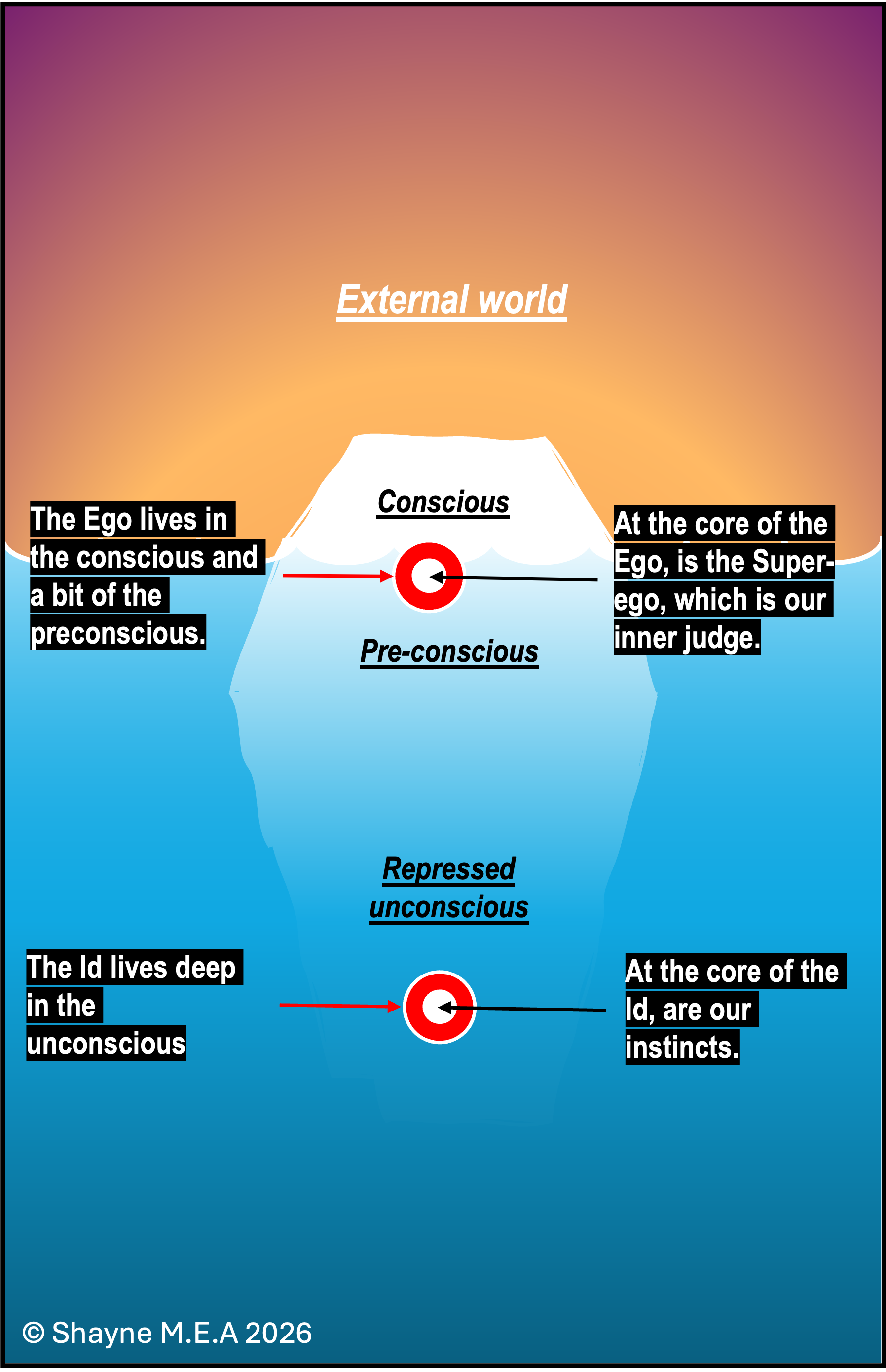
Instincts are at the core of the Id. They are the innate behaviours and that we're born with. We can think of them as our gut feelings.
Instincts
There are two main instincts:
- Eros: this comes from our sexual desires (or our libido), and manifests itself in the form of creativity. The Eros contains the survival instinct.
- The death instinct: this is the want to go back to a lifeless state.
The Id neither loves or hates the Ego, and it has no direct goal. It is instead a melting pot of raw impulses caused by the Eros and the death instinct constantly battling each other. Deep down, the Id is being pulled back and forth between the will to live and the will to die.
So together, life exists in-between this struggle between the two forces, the want to survive and the want to go back to a lifeless state.
Both instincts are thought to exist in every living subject, but not in equal parts. Freud suggests that the Eros is the predominant instinct.
It's hard to say whether these two instincts are completely separate and whether the love instinct is just about love and the hate instinct is just about destruction and hate, because sometimes love can turn into hate and hate can turn into love or sometimes an individual may love and hate someone at the same time.
Example Homosexuality
A homosexual might have initial feelings of love, but if they believe the behaviour is unacceptable, their mind turns it into feelings of hate. Or vice versa, they may hate homosexuals, but when they realise that hate is getting them nowhere, they turn to love.
In this case, there's a psychological process that happens that flips the love into hate to protect the person from feelings they couldn't accept.
We're also not fully sure how instincts interact with one another, but we do know that satisfying one instinct can cause another instinct to surface. For example, kissing can lead to the genitals being aroused.
Fusion and defusion
Sometimes the two instincts can fuse together. For example, sadistic sex. But then they can defuse, and the individual would just be obsessed with sadism.
Other examples of diffusion or partially fused instincts:
- Epilepsy
- Ambivalence
- Libido regression
In the case of ambivalence, feelings won't necessarily turn into one another, but rather the mind reassigns the energy it feels from love to hate or vice versa in a process called reactive displacement.
It's important to understand that in reactive displacement, love doesn't convert into hate, but rather there is an underlying emotional energy that shifts between the two.
Sublimation
Sublimation is where we take a socially unacceptable desire and turn it into something acceptable.
Desexualised libido
Freud believes that there's a kind of energy that stems from a part of the libido called the desexualised libido. It's a kind of sexual energy that has lost its sexual counterpart. The mind creates this energy to release tension and avoid emotional blockage. There's no rational way in which the mind releases this energy, but it does release it in some way or the other.
This energy is said to be sublimated, because the individual is redirecting sexual energy into something non-sexual, like creativity.
How the Ego deals with the Eros
When the Eros creates erotic energy, the Ego absorbs it, it desexualises the energy and shoves it into the Ego-libido, which represents a kind of desexualised love aimed at ourselves.
At infancy, the Id contains all of this erotic energy. The Ego isn't strong enough to handle it, so it develops into an outward love towards people or things around us. Once the Ego starts to mature, only then does it redirect that love towards ourselves and form a sense of narcissism. Therefore this narcissism and self-love is secondary to the primary outward love we give to the things and people around us.
Creativity and sex comes from the libido
The death instinct mainly stays silent in relation to libido related energy. Most of it comes from the Eros. Even perceptively negative energies like Sadism can often be tied to the Eros. The libido doesn't always benefit the Id, sometimes it might spur on energies that the Id doesn't want. The Id uses a pleasure principle as a compass and sometimes conflict arises from the libido spurring on energy that the pleasure principle wants to stay away from.
The Ego releases this conflicted energy, usually through sex, but also through things like creativity. After this release, the sexual instinct weakens and the death instinct grows stronger. Some animals actually die after sex.
As the Ego resolves these impulses from the libido, it becomes more loving towards itself and has a desire to live. But by absorbing these impulses the libido becomes weaker within the Id and therefore the death instinct begins to take over. Then the death instinct poses a risk. The aggression it creates ends up in the Super-ego and causes it to become more critical of the Ego. In a way the Ego creates a monster in the pursuit of dealing with the libido.
How the Ego deals with the death instinct
When the death instict creates energy, the Ego redirects it through the muscles, and into destruction and aggression towards the outside world. For example, when you feel angry, you might choose to punch something in front of you.
We all have destructive urges in the form of aggression, and we all deal with it in different ways, either by taming it, pushing it outwards or bottling it up inside. If we bottle it up too much, it turns the Super-ego into a very cruel inner critic that constantly punishes us.
Freud hypothesises that cruel Super-egos stem from a child's envy towards their Dad. together.
A child will look up to their Dad, because they're what their Mum admires, but they'll also envy their Dad, because they're an obstacle to their Mum's undivided love. So love and aggression towards their Dad are fused together.
When a child desexualises their desires towards their Dad, they begin to see them in an admiring, loving light or anything that's more socially appropriate (sublimation). In doing so, love and aggression which were previously fused together separate during the defusion process. The love part turns into admiration for their Dad, but the aggression part becomes free floating. In normal people, this free floating aggression is dealt with through a mixture of being tamed, thrown outward or by being absorbed by the Super-ego. In neurotic people all of it is absorbed by the Super-ego, causing the Super-ego to become very cruel.